Over this Easter weekend I'm becoming increasingly nostalgic about my seven years with the University of Dubuque. I am, and my entire family is, excited about my new position at St. Norbert College and all the new opportunities for us as a family. I really feel called to work with the students and the library there. Feeling called to a job is a strange and wonderful feeling. And writing about it as the sun raises on Easter Sunday feels appropriate. 
Answering that calling is not hard. What is hard is saying goodbye to the people and friendships that I've developed over the last seven years. I am very thankful for the friendship and partnerships I've made over my seven years at the University of Dubuque.
I am excited about what comes next for me, and I am excited about what comes next for the students at the University of Dubuque. The University Librarian, Mary Anne Knefel, has built an excellent team and I am lucky to have worked for and with her. I consider Mary Anne a friend and I know that I would not be the person and librarian I am today without her. When I was asked during my interview with St. Norbert who I admired, Mary Anne was first on that list. Her dedication to the staff, the library, the campus, and most importantly the students is an asset that I aspire to continue for my new community at St. Norbert College.
I know that the Charles C. Myers Library will continue to serve students and faculty extremely well. Mary Anne's leadership and the staff's commitment to quality service will go on. I am also excited and have the full confidence that Anne Marie, as the new Assistant Director, continue to improve and serve our community well beyond what I can imagine. I have written and raved about Anne Marie before, and it is all true.
Anne Marie, I am so very grateful for your friendship and our relationship as colleagues. In all my varied careers, working side by side with you has been one of my greatest joys. I've learned so much from you. I believe that our partnership was and is one of the greatest assets to the students. I am thankful you have this new opportunity and excited to see the directions you take the information literacy program.
Thank you Mary Anne, Anne Marie, the entire staff of the Charles C. Myers Library, and the University of Dubuque community.
Thank you University of Dubuque
If we build it, they will come... jump starting an information literacy program
Now that I've promoted the open position at my current library and the library has announced my replacement, it is time to talk about my new position.
I was offered and accepted a position at St. Norbert College in De Pere, WI. The college is just outside of Green Bay and is about 2000 students. You can learn more about the college here.
My new position is Information Literacy and Instruction librarian. The Todd Wehr Library has an exciting director who is moving the library forward in new and interesting ways. The staff is full of dedicated and eager people, whom I'm looking forward to working with. The campus has also just broken ground for a new library. St. Norbert College also recently announced a new President. There are a lot of changes happening on campus, and I'm excited to have the chance to be part of them.
The focus of the library is to grow and formalize their instruction program. My new position was created to build their instruction program, develop an overall plan, implement information literacy across the curriculum, and assess the program. I will also be helping train and update the library staff in pedagogy and instruction. The position has the support of faculty, the dean, and the writing center. I'm looking forward to working with them all to successfully build and jump start their information literacy program.
I'm already starting to think about the position and I will be writing about the ideas here. The chance to help jump start a program with video game strategies and pedagogy is exciting. The library staff are interested for my experience with video games and student engagement.
It is an exciting position with many challenges, but I know that what I've learned at the University of Dubuque will help me bring this same level of quality service provided by the Charles C. Myers Library to other students. I have the opportunity to help serve students and help contribute to their overall education.
While I'm shifting positions, colleges, and cities - my focus, research, and instructional application of video games in information literacy will continue. I hope that you will join me in this new application and adventure.
You Know Someone Who Wants this Job!
Now that my transition is official around campus and my replacement is determined, there is an official opening at the Charles C. Myers at the University of Dubuque. And please if you know someone who is looking - pass this along.
If you or anyone you know is looking for a creative, innovative, collaborative environment to work and grow... the University of Dubuque is an excellent choice. The full job description is listed on the University's HR page.
The Charles C. Myers Library is an excellent place to work. The environment is supportive. The people are wonderful both as colleagues and partners. I would not have accomplished what I have without the support and assistance of the librarians and staff at the Charles C. Myers Library. It is a great place and this open position is a great way to join an amazing staff. I strongly encourage anyone interested to apply.
Reference & Instruction Librarian
The Charles C. Myers Library at the University of Dubuque is looking for a creative, dynamic Reference & Instruction Librarian to contribute to an innovative team dedicated to providing outstanding service to the University. This full-time position participates in all aspects of the first-year information literacy program; serves as liaison to several departments to develop the collection and information literacy program; and provides reference services to students and faculty. One evening per week and occasional weekend hours are required during the academic year. Available June 1.
Qualifications: Required: ALA-accredited library degree (MLS or equivalent); demonstrated teaching excellence; demonstrated knowledge of current trends in information literacy, transition to college, and higher education; demonstrated knowledge of relevant tools including Web 2.0 technologies; excellent problem-solving, communication, and interpersonal skills; ability to manage change, work independently, and collaborate both with the library staff and UD community to provide innovative service in a dynamic environment. Preferred: Experience in an academic library, experience in information literacy and reference.
Apply online at www.dbq.edu or send a letter of application, resume, and three current references to: Human Resources, University of Dubuque, 2000 University Avenue, Dubuque, IA 52001. Visit us at www.dbq.edu.
AA/EOE
Out from under my blogging blackout
Wow, I'm sorry.
2 weeks since my last post. Ouch.
Reason: I'm moving. Moving jobs. Moving houses. Moving cities.
The last few months were filled with a lot of decisions, some easy, some incredibly challenging. It's been almost a month since I received a job offer, struggled through the discernment process, had multiple conversations with both my current and future employer, and come to a decision. As of June, I will have a new position at a new college.
Since my last post, I told my employer of my decision and spent the following week talking with the rest of the staff about my decision, thanking them for all that I've learned, and working through my personal emotional fallout. Moving on after seven years, puts a strain on a lot of working relationships and friendships. Part of my blogging blackout, was devoted to both the time and emotional focus to work through these transitions.
The rest of my blogging blackout and my free time was eaten up by preparing our house for sale, finding a buyer, working with them through the paperwork, looking for a new house, and starting to pack our current house. Between cleaning, fixing, packing, and searching my evenings were booked. Granted we still are looking for a house and packing... but having a buyer for our house is a huge relief.
So with all the changes, stress, and excitement over the last few weeks, I'm glad to be through most of it and moving on and looking ahead. I'll be back and blogging on a more consistent basis again.
"Reading isn't dying, just look up from behind your book."
My final wrap-up post from the Iowa ACRL Spring Conference is to take issue with one presentation claiming the death of reading. While the content of the presentation was fine, the speakers made the claim that reading is dying and because of the loss of reading many other societal benefits are dying as well.
Is reading really dying?
Or is it just changing?
The statistics given in the session focused on pleasure reading and fiction reading. 21% of high school students in 2004 read little or nothing for pleasure. 39% of 1st year college students in 2005 read little or nothing for pleasure.
Now, I remember my reading habits taking a dive in college because there was so much reading to do for school that I was soured to reading more. But my issue with their claim isn't with some personal experience, it is with the larger definition. Reading for pleasure happens well beyond just novels. How many lines of text do students read on a daily basis? How much of that is online or game based?
I would argue that high school and college students are reading. And they are reading a lot. The text in video games, the online guides, walkthroughs, and FAQs, the discussion boards, and game review sites. Video game players are reading and connecting all these various forms into one common experience. I'm reminded of a post from theshiftedlibrarian from way back in 2003. Video game players read - they are just not reading traditional texts.
Steven Johnson in his book "Everything Bad is Good For You" talks about this as well. Reading is judged on books because books came first. If video games or some other medium came first, it would be our benchmark. Johnson argues that it is unfair do judge reading against different mediums. Each brings unique and valuable assets.
Reading is changing. What our students are reading is changing. How we advocate reading can change a little as well.
Steven Johnson's "Everything Bad is Good For You" image via WorldCat
Video Games Provide Meaningful Context for Diversity
Earlier this week at the Iowa ACRL Spring Conference, Dr. Roberto Ibarra presented an update from his ACRL National Conference paper. His presentation, "Context Diversity and the Role of Academic Libraries," applied much of the initial findings from his "A Place to Belong: The Library as Prototype for Context Diversity." While his speech had a number of messages for libraries as a whole, I found his "high context" and "low context" discussion important to the appeal and success of video games.
Ibarra described "high context" as a need to have more social and cultural context to communicate and interact with the world. Knowledge and learning in "low context" is isolated and divorced from real world application, it is simply words and tasks. "Low context" learners do not need additional information to make the content meaningful. "High context" learners do. "High context" includes gestures, social setting, history, posture, tone, and status in addition to words and tasks. These learners see the full picture and each part as equally important.
Video games allow a player to be either high context or low context.
Players with a "low context" model can be successful in a game based on the straightforward information a game offers. They can understand the words and text in a game and give it meaning. The task are straightforward tasks the allow the player the ability to keep moving forward in the game. "Low context" players can enjoy the game and be successful with this learning diversity model.
Video games are also "high concept." Players with a "high context" learning style can understand a video game through much more than the information presented in the gameplay. Video games players gain a deeper understanding and meaning of a game with the "high context" elements are applied. Players gain the history of the character, the social tone, and the interactions with non-playable characters (NPCs), in addition to the gameplay and tasks involved in a game.
"High context" diversity, according to Ibarra, includes a personal commitment, is a nonlinear process, and applies comprehensive thinking. Many researchers have said similar things about why video games are engaging and attractive to players. The player has the choice to engage in these aspects of a game and add meaning their.
This is one reason why video games are engaging across cultures and ages. If a player is from a "low context" understanding of the world and knowledge - video games work. They appeal to the factual and direct tasks of learners. But they also work if players live in a "high context" understanding of knowledge based on the comprehensive experience that video games can offer.
Now, I'm not arguing that video games create diversity. Video games do allow all contextual diverse players to be successful. Video games can connect with players regardless of their cultural background. And this is why understanding video games' application of contextual diversity is important. Video games provide a valuable common cultural experience.
Ibarra's keynote was insightful and he pushed that we as libraries can create spaces of both "low" and "high" contextual meaning. Video games are creating diverse learning experiences and our classrooms and libraries can too.
Newly Updated Gaming Statistics
Via a post over at WIRED's Game|Life, the Entertainment Software Association (ESA) has recently updated their "Top Ten Industry Facts." Some of the facts, like the number of "E" rated versus "M" rated games and the average age of gamers (33), have not changed very much... but none the less it is good to have updated figures.Sixty-seven percent of American heads of households play computer and video games.
Gaming spans generations and genders.
Thirty-eight percent of all game players are women. In fact, women over the age of 18 represent a significantly greater portion of the game-playing population (31%) than boys age 17 or younger (20%).Thirty-six percent of American parents say they play computer and video games. Further, 80 percent of gamer parents say they play video games with their kids. Sixty-six percent feel that playing games has brought their families closer together.
Video games, like any other media, can be a family experience. The Wii has brought this to the cultural forefront, but parents gaming with their children is always a positive experience for both parent and child - regardless of the system or platform.
Forty-nine percent of game players say they play games online one or more hours per week. In addition, 34 percent of heads of households play games on a wireless device, such as a cell phone or PDA, up from 20 percent in 2002.
Video games are more than home consoles, handhelds, and PCs. As devices become more technologically advanced gaming will continue to expand.
Questions from "The Road to Information Literacy Championships"
Yesterday I wrote about the questions from the audience. There were a number of good questions that both clarified some points from my presentation and expanded the scope of applying fantasy sports to information literacy. Below are two of the questions asked and the my comments and reflections on them.
Challenges & Roadblocks 
1. "What about women?" Yes, fantasy sports are dominated by males, but the gender gap is shrinking. Granted, it's a huge (95% male) gap. The truth is that female interest in football or in other sports should not be discounted and assumed to be nonexistent. While fantasy sports outreach should be targeted across genders, there are other ways to apply bridging real life experiences to information literacy.
Last fall, The University of Dubuque applied a similar lesson as the fantasy football one to movie reviews. Students were asked to choose which movie they thought scored the highest and then had a little time to dig and report the results. The same evaluation criteria that were discussed in the fantasy football lesson applied to this lesson as well. Any way that we can connect students' existing experiences to information literacy we can help them not only understand the concepts but the applications as well.
2. Doesn't this promote gambling? 
I told the person in the audience the truth - "It doesn't matter if it does or doesn't, what we do will not stop students."
Now while this is easy and rather glib to say, it doesn’t answer the question. I did go on to truly answer the question, and it really depends on what the attitude and concerns are of your campus and community. If this question is being raised, gambling is a concern. And in places like this, talk about fantasy football as an example and application of the information tools students and patrons need to be successful.
The University of Dubuque framed this as a way to help students understand information literacy skills and gain confidence in their ability to apply them.
Now if you are at campus or in a community that isn’t raising the gambling question – then run with it. Promote your library’s involvement to students and patrons in terms of “build a better fantasy football team” or “how to succeed in the draft.” Talk about it in terms that is meaningful for the audience. But keep the information literacy talking points handy for faculty and administrators wanting more information.
Fantasy Football: The Road to Information Literacy Championships
Thank you. Thank you for everyone that came to my presentation this morning at the Iowa ACRL conference. I was incredibly pleased with the turnout and the questions from the audience. The energy that the audience had was wonderful and it really seemed that people left with some new ideas about connecting information literacy to students.
The bridge metaphor isn't new. And I have to thank David Warlick for introducing me to the bridge metaphor. Fantasy football, video games, and many other cultural experiences contain useful information literacy skills that we can help our students recognize and build on.
For those asking and for everyone interested, here is the link to the powerpoint slides I used. Granted they were in widescreen format, so a few images might be off if you are not using 2007.
As always, any feedback, questions, or comments on the slides is welcomed.
Note: I started this post on Monday, but for a number of reasons it is going up late.
Fantasy Football Toolkit
What do you need to apply fantasy football to your library?
What resources do you want to use fantasy football for information literacy?
What resources do you need to start fantasy leagues at your library?
The Fantasy Football Librarian, Sara Holladay, and I are working on a fantasy football toolkit and I want your feedback and input. What resources should be included. Sara and I are presenting at LOEX and LOEX of the West this summer about fantasy sports and the connection to information literacy. In addition to information literacy, we are looking at how fantasy sports can be used for community building and patron outreach as well.
The initial template for Fantasy Football Toolkit includes:
- Fantasy Football 101
- What is fantasy football
- How does one play
- General rules & strategies
- League Setup
- Options for setup
- Scoring
- Suggested online league managers
- Draft Board
- Resources to bring patrons together for a community building draft
- Suggested Resources
- Print and online sources
- Varying scope and focus
- Promotional Materials
- Suggested Lessons
So what would you need?
Photo by Rochie

ACRL Information Literacy Standards for Fantasy Football
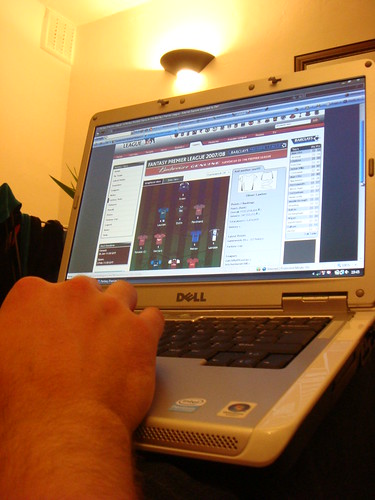
As I'm preparing for my fantasy football presentation, I wanted to provide the ACRL standards handout. I hope this can be a resource to help provide evidence to others about the information value in fantasy sports. You can download the file here… ACRL Information Literacy Standards. ACRL Information Literacy Standard ACRL Indicator Fantasy Football Activity Standard 1: "The information literate student determines the nature and extent of the information needed." Indicator 1: "The information literate student defines and articulates the need for information literacy." As players determine the strengths and weaknesses of their team, they need to decide on what information is needed to make decision. Players need to know what positions are required and what strong roster match-ups exist. Players explore general information sources in order to gain a specific focus relative to their needs. Standard 1 Indicator 2: "The information literate student identifies a variety of types and formats of potential sources for information." Fantasy players identify a variety of sources including: printed guides, websites, interviews, peer conversations, forum discussions for information. Players then construct information from the raw data (game statistics) from the box score primary sources. Standard 1 Indicator 3: "The information literate student considers the costs and benefits of acquiring the needed information." With the expansion of internet and print resources, players determine what information is available for free and what is fee based. Players weigh this information with the potential benefits of each source before deciding what information required. Standard 2: "The information literate student accesses needed information effectively and efficiently." Indicator 2: "The information literate student constructs and implements effectively designed search strategies." In order to find the information desired, players identify what terms (positions, players, keywords) to search for. This search process implements a variety of retrieval methods to find the required material. Standard 2 Indicator 3: "The information literate student retrieves information online or in person using a variety of methods." Fantasy players use chats, forums, call-in shows, interviews, email letters to gain primary information from sports writers and other experts. Standard 2 Indicator 4: "The information literate student refines the search strategy if necessary." Players assesses the quality the information they obtained and determines if they have enough to make roster, player, draft decision. During this process, players identify gaps in their information and repeats any searches. ACRL Information Literacy Standard ACRL Indicator Fantasy Football Activity Standard 2 Indicator 5: "The information literate student extracts, records, and manages the information and its sources." Many players create personalized organizational systems like spreadsheets and draft cheat sheets organize their information. Players track citation of sources in order to come back to the information and analysis during the season. Standard 3: "The information literate student summarizes the main ideas to be extracted from the information gathered." Indicator 1: "The information literate student summarizes the main ideas to be extracted from the information gathered." Fantasy players reads source content and selects the key data that applies to need (roster, team, match-up). Standard 3 Indicator 2: "The information literate student articulates and applies initial criteria for evaluation both the information and its sources." Players determine the reliability, bias, validity, authority and timeliness of sources in order to make roster and drafting decisions. It is important for fantasy players to recognizes the potential prejudice in fan based sites compared to professional sites in order to make informed decisions. Standard 3 Indicator 3: "The information literate student synthesizes main ideas to construct new concepts." Team owners recognize trends and relationships in statistics (primary sources) and commentaries in order to make roster decisions. Players often use spreadsheets and tables to construct comparison charts and rankings for drafting a roster. Standard 3 Indicator 4: "The information literate student compares new knowledge with prior knowledge to determine the value added, contradictions, or other unique characteristics of the information." Based on the knowledge the player gained, they decide if they have enough information to make a roster decision. As the season progresses, the players integrate new and ongoing information with previous knowledge to make timely decisions about their rosters and teams Standard 3 Indicator 5: "The information literate student determines whether the new knowledge has an impact on the individuals' value system and takes steps to reconcile the differences." Players encounter commentaries and information that contract their own beliefs on teams/athletes and their value. Based on their evaluation of this information, the player how and if the information will impact their roster. ACRL Information Literacy Standard ACRL Indicator Fantasy Football Activity Standard 3 Indicator 6: "The information literate student validates understanding and interpretation of the information through discourse with other individuals, subject-area experts, and / or practitioners" Players engage in personal and electronic discussions about players and roster decisions to gain additional knowledge on their players and roster choices. Throughout any fantasy sports season, players can seek expert opinions through weekly shows and chats conducted by paid professionals like writers for ESPN, NFL, and CBS.com. Standard 4: "The information literate student, individually or as a member of a group, uses information effectively to accomplish a specific purpose." Indicator 1: "The information literate student applies new and prior information to the planning and creation of a particular product or performance." The player articulates the knowledge gained in the drafting process and weekly roster moves every time they begin a new week. Standard 4 Indicator 2: "The information literate student revises the development process for the product or performance." After every match-up, the player reflects on the process and the results (win/loss) to determine future strategies.
Fanasty Football as Kuhlthau's Research Process
This past week, I've been scrambling getting two presentations ready for an Iowa ACRL conference. One presentation follows up the C&RL News article on Information Literacy and Fantasy Football.
The opening of my presentation is below. Because the audience has various experience with fantasy sports, I am connecting it to Carol Kuhlthau's library research process. Fantasy football is a research process and putting it in the Kuhlthau model makes that connection even more clearly.
Not Only Teaching with Gaming Strategies, but Displaying Them as Well
From the start of the new semester (until the end of this month), the Charles C. Myers Library at the University of Dubuque had a video game display. The display was planned to highlight some of the resources for our computer graphics students focusing on game development. I was pleased to see the appeal of the display expand beyond the intended audience. Many other students continued to stop and look and ask about checking out the books. Even some of the students touring perspective students highlighted the displays. The display has now also built up some awareness for the new video game collection.
I am pleased and surprised that the displays and the collection were not suggested or advocated by me. It's great to see more investment in the idea of video games and libraries from others on the library staff.


GDC 2008: Additional Coverage on Nora Paul's Journalism Game

After a busy week of teaching and shoveling out of more Midwest ice & snow, I'm finally catching up on my RSS feeds covering the GDC conference. I wrote earlier in the week on a couple educational focused sessions and some coverage on Nora Paul's mod of NeverWinter Nights. Some of the mainstream video game press covered the session about the University of Minnesota's journalism game.
Kotaku's Brain Crecente (who the game is named after) had a detailed write-up of the session and some more background of the game's history:
Christ Baker over at WIRED's Game|Life had another write-up, including some personal observations:"The idea was to develop a game that would reinforce good reporting practices."
In the game, the players take on the role of a reporter (no, not me) who is covering an accident in which a train carrying anhydrous ammonia hits a truck and derails, forcing the evacuation of the surrounding neighborhood.
"We had to create the city...22 different characters," she said.
Students had to figure out what story angle they wanted to take, covering the health, public safety, transportation safety or environmental issues, before getting started. Once they figured that out that have to identify the important questions, collect the necessary background information, find the right sources and interview them, keep notes, and eventually return to the newsroom to write and file a story to the paper's website.
I look forward to reading more about the experience of creating the game and how the application works out. Last year, presentation slides and other materials were posted about a few weeks after the conference. So I'm hopeful that the session's slides will appear sometime in March.Paul says that they were pleased with the result, though there were some bugs and bad design choices. Students didn't like that their avatar didn't have a cell phone, and needed to go back to the office every time they wanted to call a source and set up an interview. The sword and sorcery trappings of NWN were minimized, but still present. For instance, the editor character is built off an ogre-like NWN character type. (Some reporters who consulted on the game said that seemed entirely appropriate to them.)
Due to a programming bug, the ogre/editor will block the virtual Crecente's exit from the newspaper office, and the only way to leave is to do battle hand let him kill you.
It looks kludgey and low tech, which Paul freely cops to. The team at the University of Minnesota are reworking the game on a newer engine. Still, the game seems like it has the potential to be a useful teaching tool.
Photo by Kotaku
Gaming Strategy Resource Review Activity - Overview
Yesterday I wrote about four semester's worth of a review activity using video game strategies. Since I've finally finished up some edits and corrections to my ACRL Gaming & Academic Libraries chapter, I wanted to share part of the chapter discussing this activity. I've had a few questions about the basics of the activity - hop efully this is useful.
The lesson applied the gaming strategies of encouraging inquiry, open-ended exploration, context bridging, scaffolding, and personalization. The students in the course were grouped and given a research question that asked them to find a source within a given format (book, article, website; print or online). The goals worked to motivate the groups and kept them working toward the objective. The students quickly ran through the search process to reach the goal, a logical action within the context of games. Given the specific goal, the students worked to reach that goal in order to complete the challenge as quickly as possible. The challenge the librarians faced was to ask questions of the students and expose their search process more. The video game strategies were effective for engaging the students in discussions about why they took the search path they did. The librarians used a rubric to assess the students’ discussion of how they reached their research source. When asked, the students explained the search choices they made and provided examples that met the rubric.
The lesson incorporated gaming strategies to provide an open-ended exercise and allowed students to explore and find their own way. The students were initially challenged by how to get started with this open-ended lesson. The initial session did not clearly define the learning goals, and because of the large degree of personal exploration the lesson encouraged, the students struggled to get started in the activity. The successive attempts at the lesson provided the students with a framework for the activity. By foreshadowing the lesson a little more, each group was much more willing to dive into the activity, explore the search, and complete the goal. The initial setup of some framework not only allowed the students the confidence to jump in and get started but also created more buy-in and motivation for the overall activity.
Four Semesters of Video Game Strategies in Information Literacy
This week marked the fourth semester that the information literacy team at the University of Dubuque applied video game strategies into a resource review activity. The activity was originally designed in the spring semester of 2006 as a way to address student fatigue late in a semester. The following semester, we added video game strategies which included: personalization and open-ended/nonlinear navigation.
Over the four semesters, we modified the activity to make the goals more clear and change when we conduct the activity during a semester. At first we used the review at the end of a semester, but based on student feedback we moved the activity to the middle of the semester. It now serves as a review after the set of information literacy instruction. It works very well as a review and occasionally an introduction for some students who didn’t use certain types of sources previously. We’ve received a variety of verbal and written feedback over the semesters. Most students provided positive feedback including:
“I thought the activity was useful, however, it seemed to be a big review… But reviews are always helpful–it made me feel like I knew what I was doing and I feel really confident in my research skills.”
And some constructive negative feedback as well:
“It was a fun activity but we did already know how to find research since we had already done two papers.”
The biggest challenge the activity has faced has not been if the students do well, or the gaming strategies successfully engage students. The biggest challenge has come internally from the librarians resisting the urge to over-structure the activity. In an effort to make the goals clearer for the students, we have struggled against a traditional desire to define the entire process and path of the assignment. The temptation is understandable given traditional instruction that clearly lays out the steps and the process for the students. While the librarians agree with the application of video game strategies, it can be challenging to keep the activity open. Being willing to accept and discuss whatever results the students arrive at, even if they go against what we just taught them, are an important.
When I first used this lesson, I was impressed with the variety paths students used to get to the same sources. The activity can teach both students and librarians a lot, if we allow to the students to choose and trust that regardless of the path and the results there is something to learn.
University of Dubuque Annouces Video Game Collection

The library at the University of Dubuque launched a video game collection last week. The collection is currently around 40 - 50 titles from PS2, PS3, Xbox 360, and Wii systems and is based off a core titles list I developed last spring. The collection is developed to provide supporting material for the Computer Graphics department and recreational entertainment. The list of titles is based on the criteria I applied last year.
The games are indexed in the libraries catalog. Here's a link to some of the catalog records.
The collection has been on the shelves for just a week and without any promotion, already over 30% of the titles are checked out. Xbox 360 and Wii titles have seen the most circulation.
I'm excited about adding video games to the collection and recognizing games as a valuable media. It will be interesting to see the collection develop and how students and faculty respond to it.

GDC 2008: NeverWinter Nights Teaching Journalism
This story comes from Serious Games Source and provides a lot more detail on the University of Minnesota program that's using a mod of NeverWinter Nights to teach journalism skills. You can find the full story here.
The principle behind the game is to teach the method and reasoning of information-gathering and synthesis, and communication-related analysis skills. As video games are, as a medium, essentially a simulation of the decision-making process, they provide a powerful tool for exploring the hypothetical implications of the player's choices. In contrast to the typical academic model of learning, where success is measured in terms of making the correct choices, video games follow a more naturalistic method, where every mistake adds to the player's overall sense of understanding, leading to a more nuanced grasp of the problem at hand.
Paul's game involves a crashed tanker truck, leaking a poisonous gas that has forced an evacuation of a downtown area. The player has to interview subjects, cross-reference accounts, and generally figure out how to interpret a broad and conflicting pool of information, much of which takes specific skill and nuance to wheedle out of subjects.
GDC 2008: Serious Games Summit Sessions to Watch
Today starts the Game Developers Conference and part of the conference is the Serious Game Summit. Last year there were quite a few sessions with educational applications. Matthew Weise, one of the designers of Revolution spoke last year. I'm looking forward to a couple of sessions at the Serious Games Summit and the conference overall. GDC usually posts conference materials and even video from the conference on their site (here are the proceedings from previous years).
Here are 3 sessions from the Serious Games Summit that I'm looking forward to reading more about:
Greg Trefry spoke at last summer's GLLS about big games and libraries. GAMESTAR and looking at teaching students to how to design games could have applications in helping students create games around content from the curriculum. Any game that helps teach game design could also be useful for librarians interested in designing their own games and learning the basics of design.
I've talked about The Redistricting Game and how well it hits the actual practice of redistricting right on the head. The creators are talking about their experiences in two different parts and will be adapting the game based on feedback from the audience. It should be interesting.GAMESTAR MECHANIC: Learning through Game Design
Speaker(s): Katie Salen (Parsons School of Design), Greg Trefry (Gamelab)
Time: 10-10:30am
This session takes on serious games from the perspective of thinking, creating, and learning through making games. GAMESTAR MECHANIC, a commercial online game produced in a unique collaboration between Gamelab and the GAPPs group at University of Wisconsin at Madison, is designed to teach players the fundamentals of game design. Designed to teach young people how to design games by giving them the tools and learning space in which to do it quickly, collaboratively, and easily, GAMESTAR proposes a model for learning that extends traditional notions around game-based learning.In GAMESTAR players are invited into a narrative world situated within a social network to design, trade, and modify their own small, web-based games. In building games in this environment it is hoped that students not only learn about game design but about how to essentially build literacy about the systems and/or content that their games are based upon.
This session will demo the game and discuss strategies for assessment of the design-based skills that emerge from game-play, offering models for understanding what and how players are learning.
Finally, I don't know much about this application of NeverWinter Nights, but I'm looking forward to learning more about another application and mod of the game.Make this Game Better: THE REDISTRICTING GAME (Part I)
Speaker(s): Chris Swain (University of Southern California)
Time: 10:30-11am
In 2007 Chris Swain lead a USC Annenberg School team to design a serious game with the purpose of helping the public understand the process of legislative redistricting and reforms related to redistricting. Redistricting is the process of producing defined geographic boundaries of population which are represented in Congress or the state legislature. As more and more powerful demographic systems and mapping software have become available, redistricting has grown into a very elite game of optimization also known as gerrymandering. Each side in the process (essentially the two major political parties) attempts to push a slate of designed districts it feels are advantageous to their party's candidates through the legislative and negotiation process. The results can sometimes be astoundingly bizarre shaped districts and ultimately result in voter confusion and disenfranchisement from the entire process.THE REDISTRICTING GAME tries to capture the core yearning for optimization process that exists in redistricting but then attempts to show users various proposed reforms in the process as new constraints on the rules of the game. Users are then given links to various reform sites as well.
The game is now out and fully playable. Like all games there are many ideas that never made it through the final cut. In this session, Chris will present the full version of THE REDISTRICTING GAME. Two leads from the audience will be announced and then each lead will have over 24 hours to compile ideas into a quick presentation for the following day detailing an imagined 2.0 version of the game and associated project. The goal of this session is not to just make the game itself better but to figure out new ideas the potentially improve the impact of the project's mission. After the presentations the audience will be given a chance to respond. Chris will then offer some rebuttal and comments to the efforts allowing insight into why certain ideas may or may not work from his standpoint as the team lead.
Being Brian Crecente: Using an Off-The-Shelf Role Playing Game to Teach Journalism
Speaker(s): Nora Paul (University of Minnesota)
Time: 5-5:30pm
This session details The University of Minnesota's efforts to develop a role-playing game to teach journalism. Working together, professors Kathleen Hansen and Nora Paul lead a team that modified Bioware's NEVERWINTER NIGHTS to teach interview techniques and more to budding journalism students.The process of using an off-the-shelf game engine offered unique challenges and insights into how others might attempt to build future serious games. Matching common RPG play (especially Bioware ones!) to journalism was a perfect fit. In the game, students move around Harperville and cover the story of a toxic spill caused by a train derailment. Students must investigate and find their angle to the story and file it. NPCs will offer no comment and react to your style of questioning as well.
After detailing the project, discussion will turn to lessons learned and how the next version of the project is moving along providing insight into the iterative learning process many serious game designs require of their proponents.
all session descriptions from Game Developers Conference 2008
ESL Database Introduction: Video Game Strategy Application
Earlier this week I was asked to help develop a lesson for a class of ESL students. They were working on a very basic research paper on a current social issue. I wanted the session to be open ended and student directed while still giving the ESL students a librarian and peer support structure.
The lesson plan and sample powerpoint slides are here
The lesson includes the video game strategies of continually feedback, personalization, production, clear learning goals, lowered barriers to failure, and situated meaning.
Some of the ESL accommodations include:
- Instructions written, spoke, and displayed on screen for multiple access and reinforcement
- Additional visual handouts that use screen shots to show steps through each database
- Small peer groups for increased communication and reduced barriers to assistance
- Use of "objection" signs to add fun out of asking questions and incorporate the expectation of questions into the lesson; objection signs created using the Phoenix Wright image below
- Demonstration of how find resources, not an explanation or presentation; allowing the focus on process not on verbal expression
The librarian that asked for the unit, found it useful and engaging. I hope that others might find some useful in it as well.


 Posts
Posts